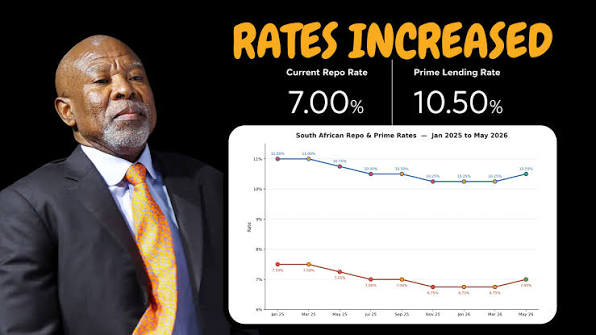
The South African Reserve Bank Hiked Rates
The SARB Just Hiked Rates -
What Does This Actually Mean If You Are Buying a Home in SA?
If you have been following the financial news over the past few weeks, you will have seen headlines about the South African Reserve Bank raising interest rates for the first time since 2023. On 28 May 2026, the Monetary Policy Committee voted four to two to increase the repo rate by 25 basis points, pushing it up to 7.00% and the prime lending rate to 10.50%.
That is understandably unsettling news if you are planning to buy a home or are already paying off a bond. But before you put your property dreams on hold, take a few minutes to read this properly, because the picture is more nuanced and more positive than the headline suggests.
What Just Happened and Why
South Africa had been in an easing cycle since September 2024. Over that period, the SARB cut rates six times, trimming a total of 150 basis points from the peak prime rate of 11.75% we saw in May 2023. That brought enormous relief to homeowners and opened the door for many first-time buyers who had been priced out of the market.
The May 2026 hike was driven primarily by inflation risks linked to the ongoing Middle East conflict, which has pushed global oil prices sharply higher. Fuel inflation in South Africa is running above 18%, and the SARB acted to prevent second-round effects from flowing through into broader consumer prices. The vote was close: four to two, which tells you this was not a decisive, confident move, but a cautious, defensive one.
Importantly, South Africa's underlying inflation position remains healthy. Inflation hit exactly 3.0% in February 2026, right on the SARB's new target. That context matters. The rate hike is a response to external pressure, not a sign that the domestic economy is overheating.
What It Means in Rand Terms for Your Bond
Here is where we bring it down to what matters for your household budget. A 25-basis-point increase translates into real money, but perhaps less than you think.
On a R1,000,000 home loan over 20 years, a 25 basis point rate hike increases your monthly repayment by approximately R167 per month. On a R1,500,000 bond, that rises to roughly R250 per month.
Put another way: if you were planning to buy a home in Mbombela, West Acres for R1.6 million with a 10% deposit, your monthly bond repayment on the R1,440,000 bond would increase by approximately R241 per month compared to what it would have been before the hike.
That is real money, and it should factor into your budgeting, but it is important to keep perspective. Prime is currently at 10.50%, down from a peak of 11.75% just two years ago. Buyers who entered the market at that peak are paying significantly more every month than you would today. The rate environment, even with this hike, remains far more favourable than in 2023.
What Happens Next, The Rate Outlook
Here is what the major South African banks and economists are saying heading into the second half of 2026:
The SARB's own Quarterly Projection Model projects the repo rate declining to approximately 6.31% by year-end, suggesting further cuts remain in the baseline, assuming the oil shock proves temporary.
Investec's chief economist now projects the next 25-basis-point cut for the third quarter of 2026, with the repo rate reaching 6.50% by December.
Standard Bank had previously forecast 50 basis points of cuts in 2026. While the geopolitical situation has trimmed those expectations, the bank does not expect the easing cycle to reverse.
Absa describes the bar for further rate hikes as 'quite high' and expects a delay rather than a reversal of the rate-cutting trajectory.
In plain English: the May 2026 hike is likely a speed bump, not a change of direction. The medium-term trend for interest rates in South Africa remains downward, provided global energy prices stabilise.
What Should Buyers in South Africa Do Right Now?
This is the question I get most often from clients, and my honest advice is this: do not let a 25-basis-point move derail a sound property decision.
Here is how to think about it practically:
If you are pre-approved but have not made an offer yet
Speak to your bond originator about locking in your rate now. Some banks offer rate protections for qualifying applicants. More importantly, revisit your budget ceiling and confirm your monthly repayment comfort zone at 10.50% on the prime rate, not 10.25%. The difference should not change your decision if the property is correctly priced.
If you are still saving for a deposit
The good news here is that first-time buyer activity has surged in 2026, and banks have responded by reducing average deposit requirements by approximately 15% compared to a year ago. The accessible end of the South African market, properties priced from R750,000 to R1.2 million, remains active and bank-supported. Do not assume the door has closed; speak to a bond originator first.
If you are already in the market and paying a bond
Your monthly repayment will increase by roughly R167 for every R1,000,000 on your bond. If you have been banking the savings from the previous six rate cuts rather than maintaining your original repayment, now is the time to review your financial buffer. If you maintained your original higher repayment through the cutting cycle, you are in an excellent position; you have been paying down capital faster, and this hike barely registers.
The Nelspruit Property Market Is Still Moving
Despite the rate environment, the Nelspruit and greater Mpumalanga market continues to attract buyers, particularly from Gauteng, where buyers are discovering that well-priced secure estate homes in Mbombela, priced from R1.5 million to R2 million, offer value that is simply not available closer to Johannesburg.
The fundamentals that drive our local market have not changed: proximity to Kruger National Park, the subtropical lifestyle, strong infrastructure including Mediclinic and Rob Ferreira Hospital, Mpumalanga University of Technology, and the High Court, all of which support consistent demand from professionals and families.
My view as a local property practitioner: correctly priced, quality stock in established Nelspruit suburbs will continue to sell at solid levels of enquiry. What will struggle is overpriced stock and properties in less desirable locations. Price right, buy right, and a 25-basis-point move does not change your property story.
Need Help Making Sense of the Numbers?
If you are unsure how the current rate environment affects your specific home loan situation, I am happy to walk you through the numbers. Whether you are a first-time buyer trying to understand your budget or a seller wondering how the rate hike affects your pricing strategy, let us have a conversation.
Call or WhatsApp me directly - contact details are on this page. No pressure, no obligation. Just honest advice from someone who knows this market.
Tshepo Tawane | Tshepo The Estate Agent powered by eXp Realty South Africa
PPRA Registered | FFC No. 202678008460000
Rooted in community. Driven by purpose. Built to last.